How to Identify Your Target Audience (and Why It Matters)
How to Identify Your Target Audience (and Why It Matters)
8 min read
8 min read
Take a moment to think about this: Are you wasting time, money, and brainpower on content that is constantly getting ignored? Are your conversion rates not good even after your best efforts? The truth is that you’re probably shouting into the wind because you haven’t taken the time to identify who it is that you need to let know. Marketing to "everyone" is the fastest, most expensive route to failure.
The moment you realise your audience is the key to your business, everything changes. The core reason you must focus is simple: Relevance.
As soon as you send a generic message, it simply lacks the specifics to capture someone's attention in today’s competitive online world. This leads to the "Vicious Cycle of Generic Marketing": low engagement and wasted marketing spend.
Increased ROI: You stop wasting money advertising to people who will never buy.
Higher Engagement: Your content uses the exact language your audience uses to describe their problems, making them instantly click and read.
Product/Service Alignment: You gain clarity on what features or topics your audience genuinely needs, guiding your content and product development.
Focus your entire strategy on one powerful concept: the Audience.
Before you even think about finding people, you must first think about your offering. A common mistake is defining the audience before defining the core value.
Ask yourself: What problem do I uniquely solve?
Your ideal customer is simply the person who benefits most from the solution you provide. If you sell a time-management app, your ideal customer is the person most frustrated by wasted time. If you write about vegan cooking, your ideal customer is someone struggling with healthy, plant-based meal planning. This self-assessment guarantees that your audience is genuinely motivated to listen to you.
Now, let’s build the audience who will happily engage and pay for your solution.
The four main parts of an Audience:
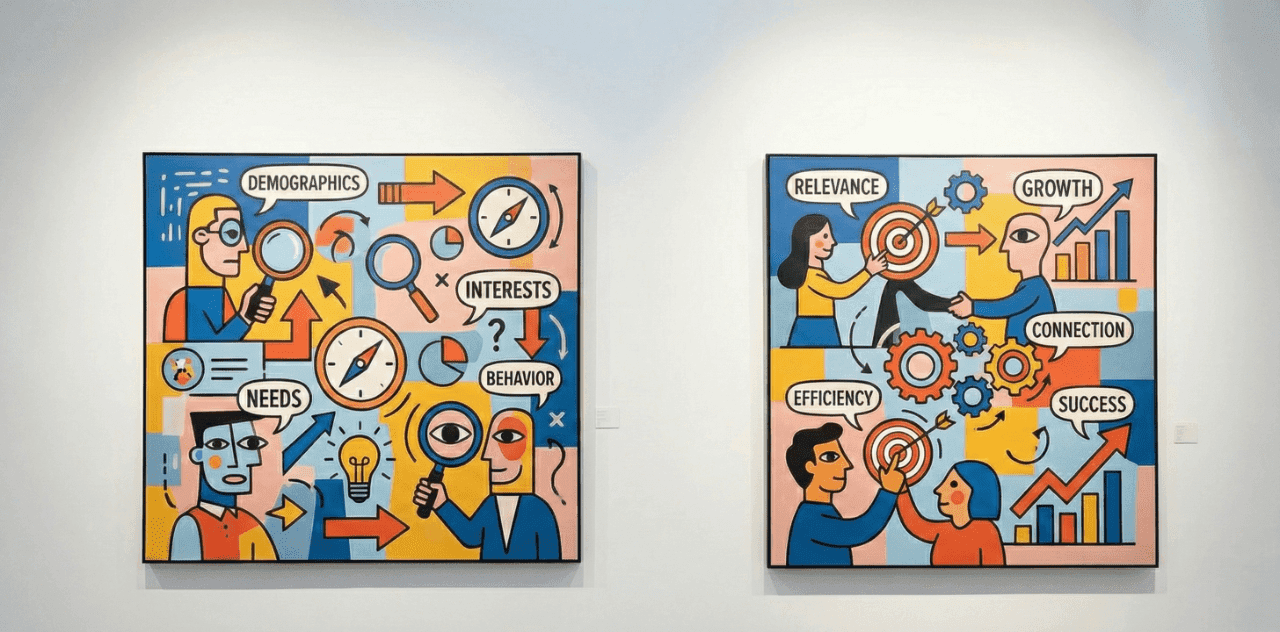
Demographics (The Who): Identify the objective data, including job title, income, education level, and location. For example: "A 35-year-old mid-level marketing manager living in a city."
Psychographics (The Why) Understand their internal world, including values, interests, and lifestyle. For example: "Values work-life balance, follows personal finance blogs, and prefers efficiency over creativity."
Pain Points (The Obstacle): What frustrates them daily? What keeps them up at night that your solution addresses? Your content must directly address these fears. Example: "Wastes two hours a day on repetitive reporting tasks."
Aspirations (The Goal): Understanding their aspirations enables you to present your product as a means to help them reach their goals. Example: "Wants to prove their worth to get a promotion and lead a small team."
When you know these four things, your content stops being a random guess and becomes a targeted, empathetic conversation. That’s when conversions start, and loyalty is built.
You don't need a massive budget to gather this data. The insights are often sitting in places you already use:
Analyse Your Current Audience: Use tools like Google Analytics (Demographics, Interests, Behaviour Flow) and Social Media Insights (who is following and engaging with your content). Identify shared characteristics among your highest-value customers.
Listen to the Conversation: Research online communities like Reddit (in relevant subreddits), niche Facebook groups, or Quora. Listen to the exact language they use to describe their problems, needs, and desires.
Review Competitors: Read the customer reviews (good and bad) on your competitor’s products or services. The "bad" reviews reveal unaddressed pain points you can solve; the "good" reviews confirm the benefits people value most.
Defining your Ideal Customer is not a theoretical exercise for marketers; it is the crucial strategy for business efficiency and sustainable growth. You’ve moved from hoping someone will listen- to specifically targeting the exact person who needs and will pay for your help. This clarity eliminates doubt, guides your budget, and gives every piece of content a clear purpose.